Classes
The concerns of a Block are quite separate from that of a BlockSet and are mainly to do with the construction of a Block object. Parsing and validation need to pay attention to
- handling the parsing of multi-dimensional data
- multiple ways to represent a block (i.e. any set of opposite corner points could be used)
- handling open limits to infinity
- handling the expression of a unit as single corner
Block
A Block is an orthogonal clump (a line segment, rectangle, cuboid, hyper... you get the idea) of discrete space defined by any opposite end/corner points A,B.
- Decimal precision can always be achieved using some desired scaling, so
coordinates of the space are always specified as
int(unless specifying an open interval, see below) - The only exception being that the
float("inf")value can be used to represent no limit (i.e. an open interval to infinity be it +/- in any of the component dimensions) - Any pair of opposite corners can be used and in any order.
- Internally the block will always be normalised such that A<B in all component dimensions.
Normalised Form
Opposite corners will always be normalised internally so that he vector AB is always positive in every component dimension.
For example
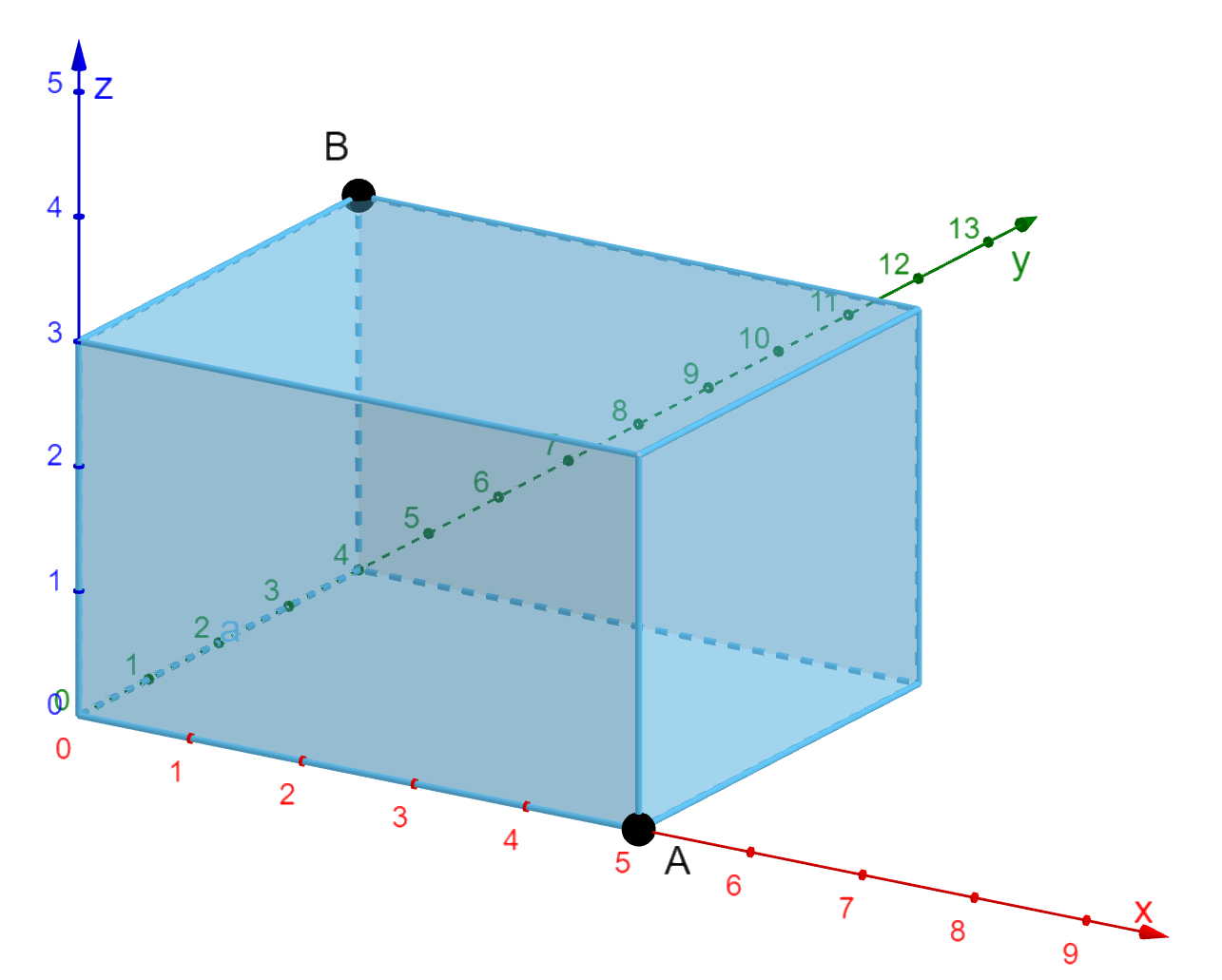
from blocksets import Block

A = (5, 0, 0)
B = (0, 4, 3)
block = Block(A, B)
print(block)

(0, 0, 0)..(5, 4, 3)
The constructor normalises the block definition using opposite corners (0,0,0) and (5,4,3).
Parsing & Validation
The Block constructor handles various argument formats and resolves them to this normalised representation if passing the following validations:
- Arguments must be either
int,+/- float("inf")or a tuple of these. - The Dimension of the 2 end/corner points must match.
- Ordinates in corresponding dimensions can not be the same value (as that would imply a block of zero space).
Constructor
The constructor expects 1 or 2 arguments which express the opposite corners A,B.
If the second argument (for the opposite end/corner) is not supplied then it is defaulted as follows for each ordinate in turn:
- For finite values we add +1 thus modelling a unit value
- For infinite values we assume the opposite end (i.e. the multiplicative inverse)
So if all values are finite then it is expressing a unit block.
Parsing
There are 2 class methods also available parse() and parse_to_dimension() which
are primarily used by the BlockSet class to handle the parsing of arguments
inline.
Operations
Finding the overlapping intersection of 2 blocks c = a & b seems reasonable.
However, union and difference make no sense as there is no guarantee you end up
with a single block as a result.
subset, superset and membership operations are also supported.
a <= ba => bunit in a
Generally, we assume that any arguments being supplied to a Block operation are attempting to express a Block.
For the in operator however, we will make an exception and assume any tuple
arguments are expressing a unit as opposed to a dereferenced list of
arguments for the Block() constructor.
This exception is in keeping with the strict notion of membership (∈) as different to subset (⊆).
BlockSet
A BlockSet is a container class for blocks mirroring the same behaviour as a
set.
However, (unlike a python set) we constrain and validate on the type of
member, we only want Block objects and they must be in the same dimension.
In order to facilitate duck typing we will convert arguments inline via parsing
methods in the Block class.
The actual construction of the set using Block objects happens via an
operation stack which gets resolved during the normalisation process in which
the stacked operations add, remove & toggle are resolved to purely add
operations of disjoint spaces.
The normalisation process resolves any overlapping and redundancy such that sets
of equal content (i.e. the same layout of units) will have the same
representation in terms of the disjoint Block objects used to represent the space.
Methods and operators mirror those of the native set class
- Content modifiers (add, remove, toggle)
- Set comparisons (equality, subset, superset, disjoint)
- Set operations (intersection, union, difference, symmetric_difference)
- In place set operations (intersection_update, update, difference_update, symmetric_difference_update)
- Use of the
inoperator will apply to a singleBlockobject
Normalisation
This is main concern of the class, taking the operation stack and resolving it to a resulting set of disjoint blocks in a consistent manner that also removes redundancy (this being where 2 adjacent blocks could have been expressed as 1 in the same consistent manner).
Normalisation is required and important (for accurate comparisons) but also costly. We only want to perform it when its absolutely necessary and so clients are advised to group together modification calls as much as possible in order to minimise the amount of normalising required and especially so if performance is of a significant concern.