blocksets



A python package for performing set operations on layouts of discrete space in any dimension.
Discrete space meaning integer amounts of unit space i.e. unit segment in 1D or a pixel in 2D (or a voxel in 3D - new term for me)
Why?
Largely inspired by advent of code puzzles that involve solving problems on integer grids in 2 or 3 dimensions and where modelling the data as sets of tuples is not practical because of the volume (i.e. lots of points over a large amount of space).
You might choose to use a BlockSet object instead of a python set of tuples
because of a need for high resolution/granularity pushing the limits of the
available computing power.
For example, say we would like to model a set of pixels in a 2D grid as a union of several rectangles.
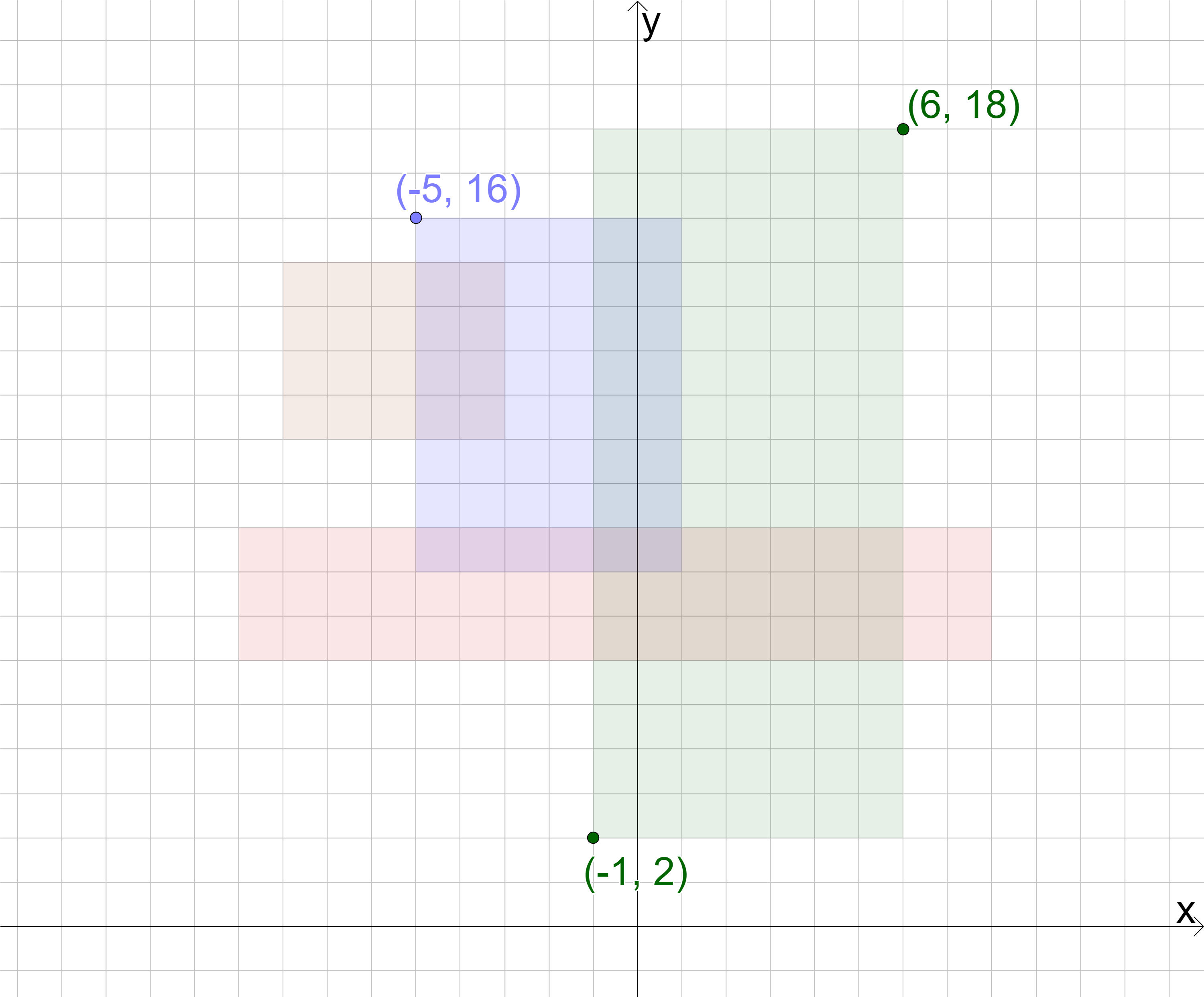
Sure, at this scale we can simply model it as a set of tuples to represent each pixel, but as the resolution increases with respect to the rectangle sizes we start to encounter computational limits on memory and search times.
The aim of blocksets is to divide any layout into easily defined chunks (i.e. lines / rectangles / cuboids etc.) in order to reduce the memory required whilst still allowing the usual set operations to be performed.
We define a block to mean a discrete space that can be defined by opposite ends/corners such as a line segment / rectangle / cuboid etc. and we aim to model any layout as a disjoint set of blocks instead of tuples.
Features & Highlights
- Multidimensional
- Support for open intervals (to infinity).
- Mirrors methods (and operators) of built-in Python sets.
- Set comparison is consistent regardless of derivation
- Iteration over a block set yields blocks.
- Iteration over a finite block yields tuples.
- Modelling of intervals/ranges is the same as a python range in that the lower limit is inclusive and the upper exclusive e.g. 1..4 = {1,2,3}
Visualisation
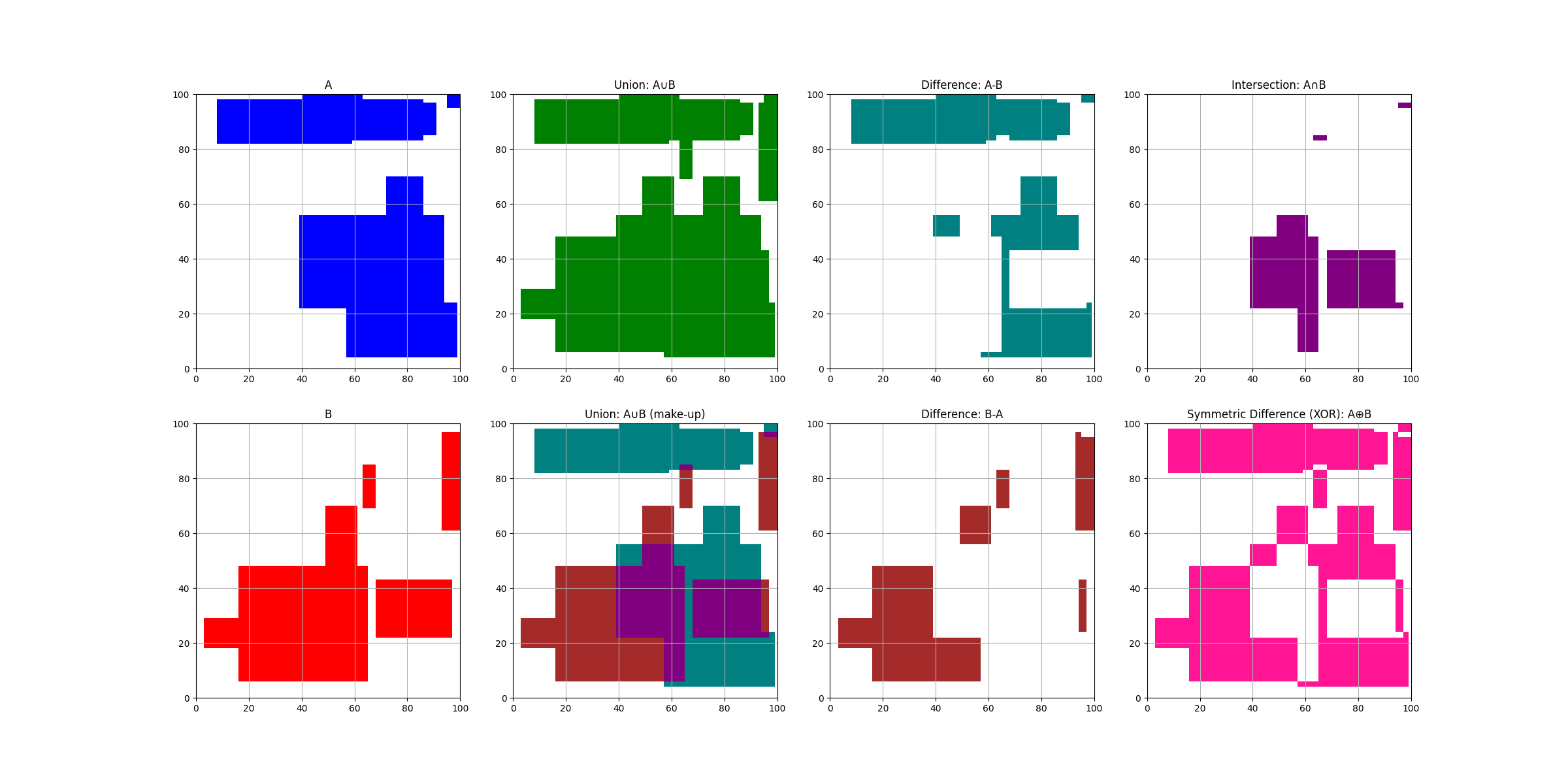
An example of 2D set operations on some randomly generated block sets A, B and
drawn using matplotlib.